
I published the YouTube video embedded below entitled “Brian May Red Special Guitars Zero Fret Wear Reasons and Replacement” on 21 April 2024 to provide a factual resource for prospective buyers and owners of Brian May Red Special guitars about why zero fret wear occurs and what can be done to alleviate the issue.
It is surprising to me how the topic of zero frets elicits strong opinions from guitarists and luthiers about whether they are a benefit compared to a conventional nut arrangement, how to install and dress them and even whether zero fret wear is a credible phenomenon. A recent comment from a player of high end acoustic guitars who is also an amateur luthier asserted that there should be no zero fret wear if the fretwire is “properly installed”. I did wonder whether the commenter had understood the point of my video which was that zero fret wear is particularly acute on Brian May Red Special guitars for reasons I explain below. Acoustic guitars do not have tremolo systems and acoustic playing styles should not cause zero fret wear.
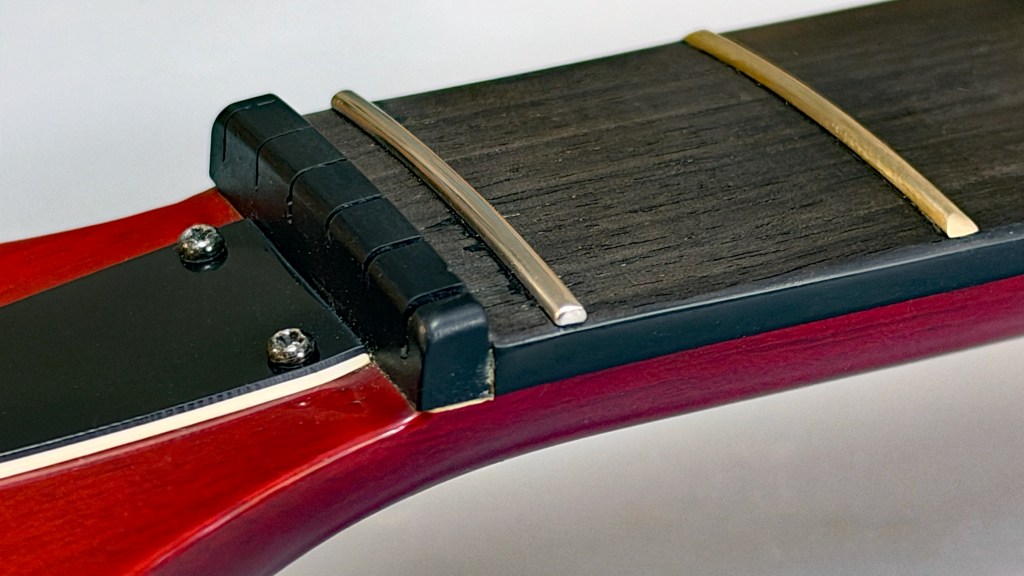
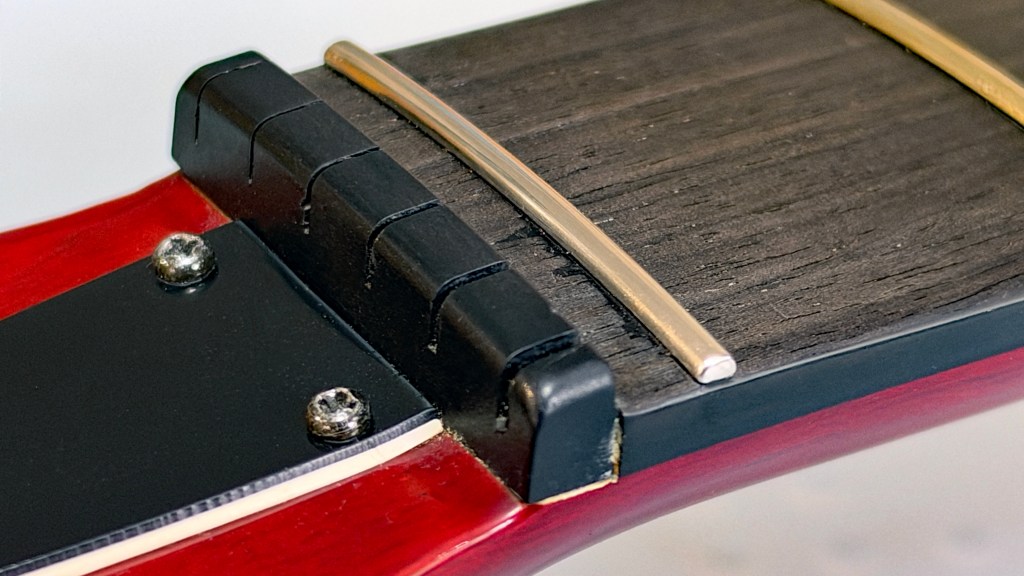
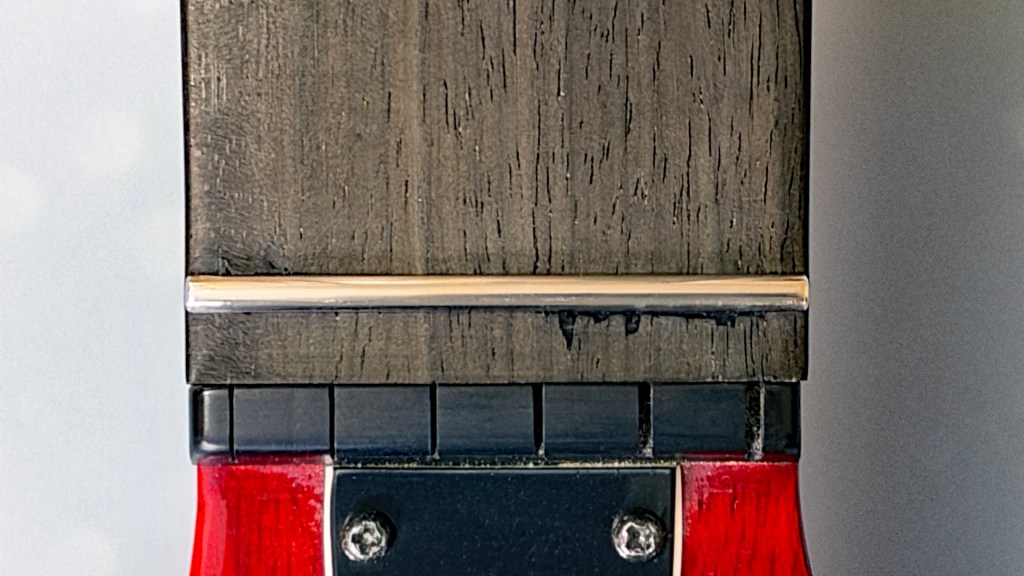
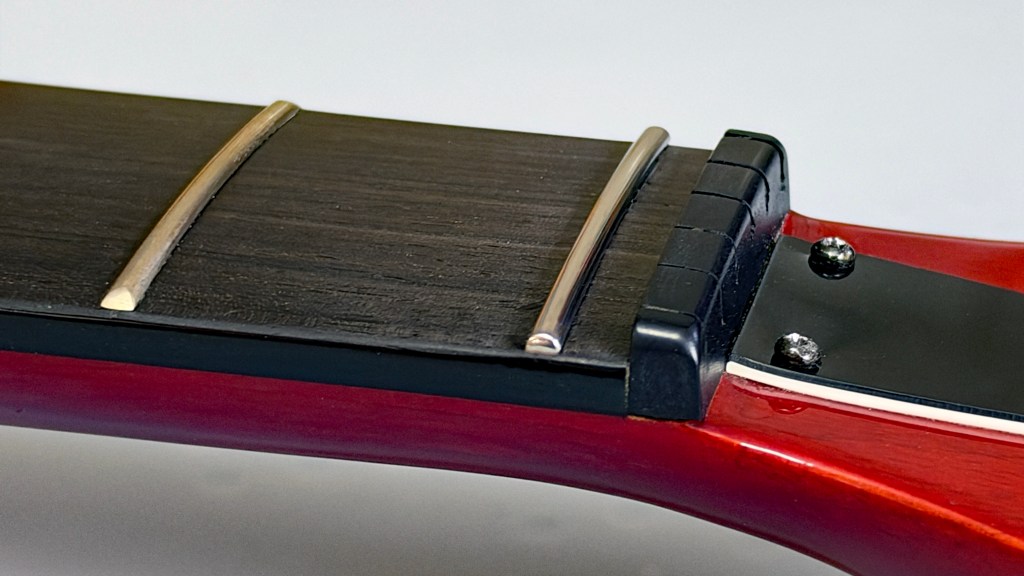
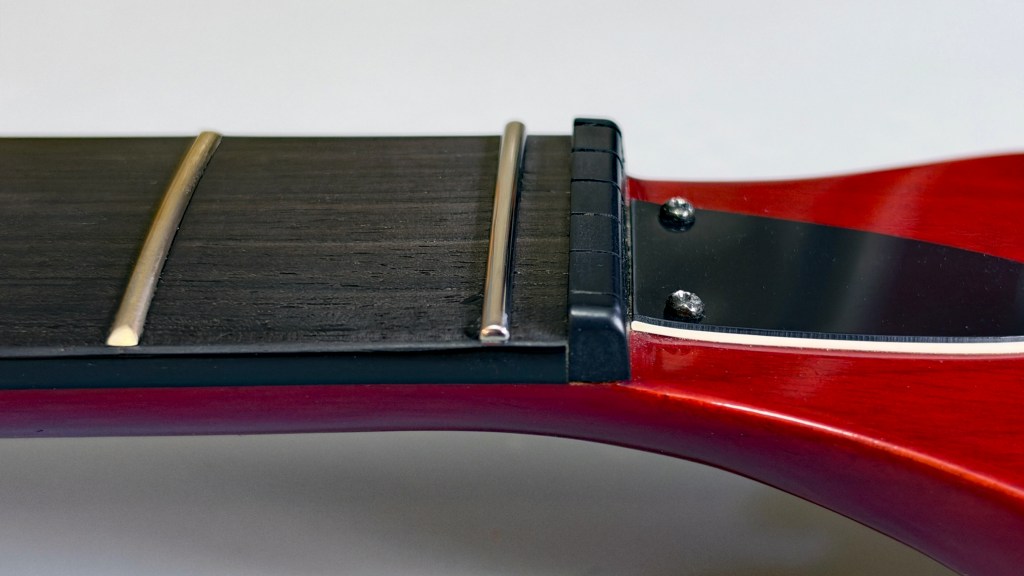
In the second part of this video, I removed the zero fret on my 2004 Burns Special and replaced it with stainless steel fretwire. This was the first time that I had attemped any re-fret work, and because I was concerned about exacerbating existing chip out on the ebony fretboard, I elected to not dress the surface. I anticipated that pressing the fret in firmly would compress the chips and seat the fretwire flush. This wasn’t the case so I eventually removed and replaced the zero fret again, dressed the surface of the ebony and made good any chip out with black cyanoacrylate superglue. In hindsight, I should have covered both replacements in the same video to avoid attracting comments that “the fretwire isn’t seated properly”. The pictures below illustrate the final outcome; note that the fretwire seat is obviously now flush.
The Reasons Why Zero Fret Wear Occurs on Brian May Red Special Guitars
(a) Tremolo use. There is an inevitable sawing action from tremolo use but I don’t use the tremolo much on my Brian May Red Special guitars so this can’t be the main reason on my Burns Special.
(b) String Bending. Brian May’s playing style involves string bending and finger vibrato techniques and this tends to occur more on the plain strings during soloing so this will certainly be a contributory factor.
(c) String tension. String tension alone can’t be a significant cause because the grooves are most prominent on the plain strings and the top E and B strings have the lowest tension. That is approximately 11.5 and 9.5 lbs respectively.
(d) Relative hardness of fretwire and string alloys. Standard nickel silver fretwire is an alloy of copper, nickel and zinc. It is likely that the alloy composition of fretwire in budget commercial guitars is higher in copper percentage and lower in zinc which will make it softer. Use of harder steel strings will exacerbate wear. I fit Rotosound British Steels stainless steel strings to all my electric guitars because they are more durable and have a brighter tone.
(e) Pressure on the Fret Crown. The thinner strings exert more pressure on the fret crown because the contact patch is smaller.
What Can be Done to Alleviate It?
Other than not using the tremolo at all, you can’t prevent this phenomenon occurring. However, since stainless steel fretwire is harder than regular nickel silver fretwire, fitting a stainless steel zero fret will certainly delay the onset of zero fret wear. If you are not a heavy tremolo user (like me) or only play the guitar occasionally (like me), then this improved durability might appear to ‘cure’ the problem.
Nickel Silver hardness: HV5 175 to 200.
Stainless Steel hardness: HV5 250 to 300.
Fitting bridge saddles with a roller element built in will reduce the overall friction in the tremolo system but it won’t directly reduce the sawing action caused by the tremolo. The string guide on a Brian May Red Special guitar is only designed to prevent gross lateral movement of the strings so fitting a roller nut won’t make any difference and might change the contact point of the strings.
Why is This Issue Worse on Commercial Red Special Guitars (BMG or Burns Specials)?
I suspect that the sawing action of the tremolo is more prominent on the commercial guitars (Burns and BMG Specials) because these guitars have a horizontal fretboard (that is a neck pitch of zero degrees relative to the guitar body) with a headstock angle of 7 degrees. The original Red Special has a neck pitch of two degrees with a headstock angle of 5 degrees. So the break angle across the zero fret is two degrees larger on the commercial guitars compared to an authentic Red Special replica.
Is it Necessary to Make the Zero Fret Higher Than the Other Frets?
Several commenters on my video pointed out that it is not necessary for the zero fret to be higher than the other frets. This is true although I hoped that it was obvious that a pragmatic approach is to install fretwire with a larger crown height, check the intonation when playing on the lower frets and if the intonation is too high, then the zero fretwire can be dressed and re-crowned. Intonation is a personal preference to some degree but received wisdom in the Brian May Red Special community is that a zero fret which is slightly (say 0.2 mm) higher than the first fret is acceptable to most players. I replaced the zero fret on my Burns Special with Jescar stainless steel fretwire. FW57110 has a 2.8 mm crown width and 1.45 mm crown height which is a good match to the jumbo 3 mm size fitted to this Burns Special.
Return to the FAQs section home page:
https://dsgb.net/faqs/

